
Kindling is building an on-line one-stop shop for the sustainable food movement in Greater Manchester after securing support from Making Local Food Work (MLFW) & Food Futures.
The website will allow:
Latest news
Some of Manchester's leading sustainable food projects visited Newcastle Upon Tyne recently to see how the country's most sustainable city was improving access to sustainable food.
The Kindling Trust in partnership with The Federation of City Farms and Community Gardens (The Fed) took individuals from Food Futures, Glebelands City Growers, Unicorn Grocery, Hulme Community Garden Centre and HERBIE to three of Newcastle's leading food projects and attended Tyneside's Grow, Cook, Eat conferenc
Kindling's Forgotten Fields project is exploring the incredible history of market gardening in Ashton Moss with local residents. Over the next few months Fiona Dunk, local historians and children of Aldwyn Primary School, Audenshaw, are carrying out inter-generational interviews with local growers.
Filming has begun on a short ten-minute film introducing FeedingManchester's definition of sustainable food. The video aims to clearly and succinctly introduce the eight elements of our collective definition and showcase a number of pioneering projects in the city delivering food that is low-carbon, healthy, fair-trade and humane.
Did you know that Manchester has a climate change action plan? It’s called “Manchester: A Certain Future” and it outlines how our city will change over the coming years and how we can help.
On the evening of Thursday 23rd September, at the Nexus Café, over eighty people came together to the 'Manchester -What's our Future?' event where voluntary and campaign groups (as well as council staff) were on hand to answer questions about the City's strategy.
We held the 5th FeedingManchester on Wednesday 20th October at MERCi's Bridge-5 Mill, with twenty five groups from across Greater Manchester meeting up for this uniquely regular opportunity to network, share and plan a sustainable food system for the city.
The agenda covered many issues throughout the day and included:
1. Updating each other with our news and progress since the last FeedingManchester in June (2010).
A new gallery on how to hand-pollinate courgettes has been created. So if you have a variety of courgette you are particularly fond of , why not harvest the seeds for planting next season?
You can't just take the seeds from any mature courgette because there is not telling what its cross-pollinated with and you may get a surprise when the new courgettes begin to grow. However, if you intervene early enough you can ensure a pure variety by hand-pollinating the female courgette flowers.
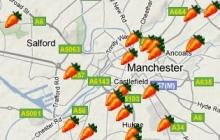
A Sustainable Food Directory for Greater Manchester is taking shape after Kindling made its fledgling database of sustainable food projects available on-line. With over a hundred and fifty independent businesses, voluntary organisations and community groups listed into categories like primary producers (e.g. growers), secondary producers like bakers; retailers, community projects and support services, the directory can be searched by name, type and location. Additionally, a map allows for easy searching.
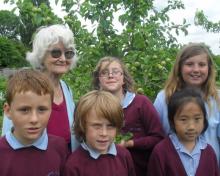
Timperley was once a well known market gardening area, from the late 1800's, supplying the city of Manchester with fresh fruit and vegetables such as strawberries, cos lettuce, tomatoes cucumbers from glasshouses and and in particular, the locally discovered variety, 'Timperley Early' rhubarb. Indeed, Heyes Lane School, who Forgotten Fields has been working with, is built on land bought by compulsory purchase from Harry Marsland who was one of the first nurserymen to grow Timperley Early.
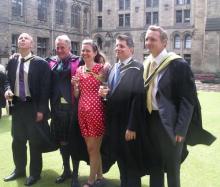
It's taken three years, an unbelievably steep learning curve, a lot of patience of friends, relations and tutors alike, and a huge amount of time – but finally, on the 9th July 2010 Helen went to Glasgow to collect her MSc (with distinction) in Organic Farming.